Office Interior Design: Transforming a 415 Sq.Ft Space into Creative Workspace

Updated: May 23
Most small offices end up looking the same — standard desks, neutral walls and layouts designed purely around functionality. But when the client for this 415 sq.ft office at Wave One, Noida approached us, the vision was very different.
As an event designer, he wanted a workspace that felt creative, unconventional and expressive rather than corporate. The office needed to function as a studio, meeting space, lounge and collaborative work environment all within a compact footprint overlooking the city skyline.
The challenge was to transform a completely raw shell into a workspace that feels inspiring, practical and visually bold without making the office feel cramped.

Designing Office Interiors Without Making It Feel Small
One of the biggest challenges in compact office interiors is balancing multiple functions within limited space. This office needed:
a comfortable workstation,
informal meeting areas,
lounge seating,
pantry functionality,
and enough openness to host casual team interactions.
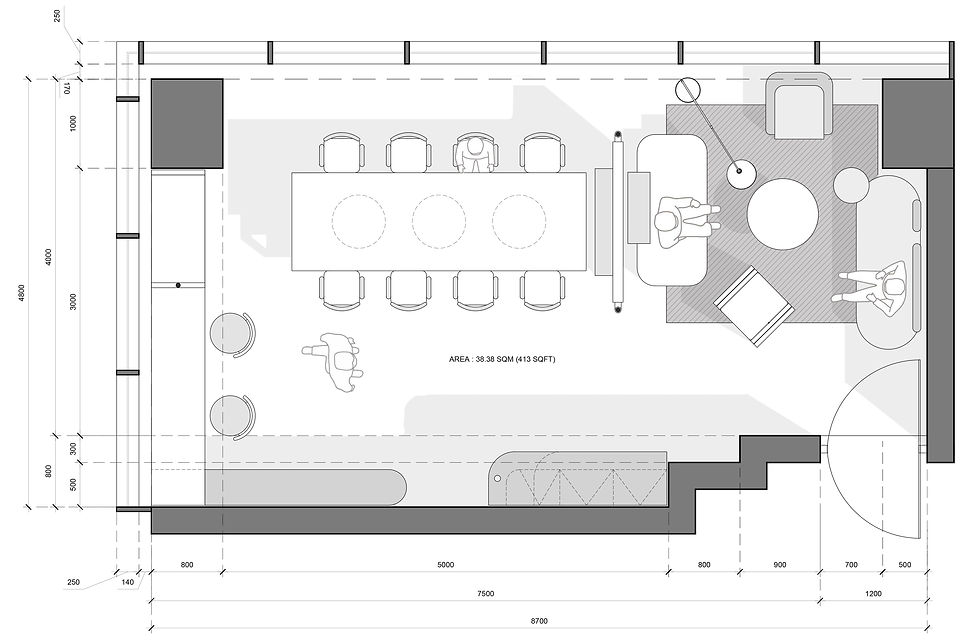
Instead of dividing the office into rigid sections, the design focused on creating fluid zones that naturally transition into one another. This helped the office feel larger and more open despite its compact size.
Design Tip: In smaller offices, avoid excessive partitions. Open visual flow instantly makes compact layouts feel larger and more breathable.
Creating a Workspace That Feels Creative
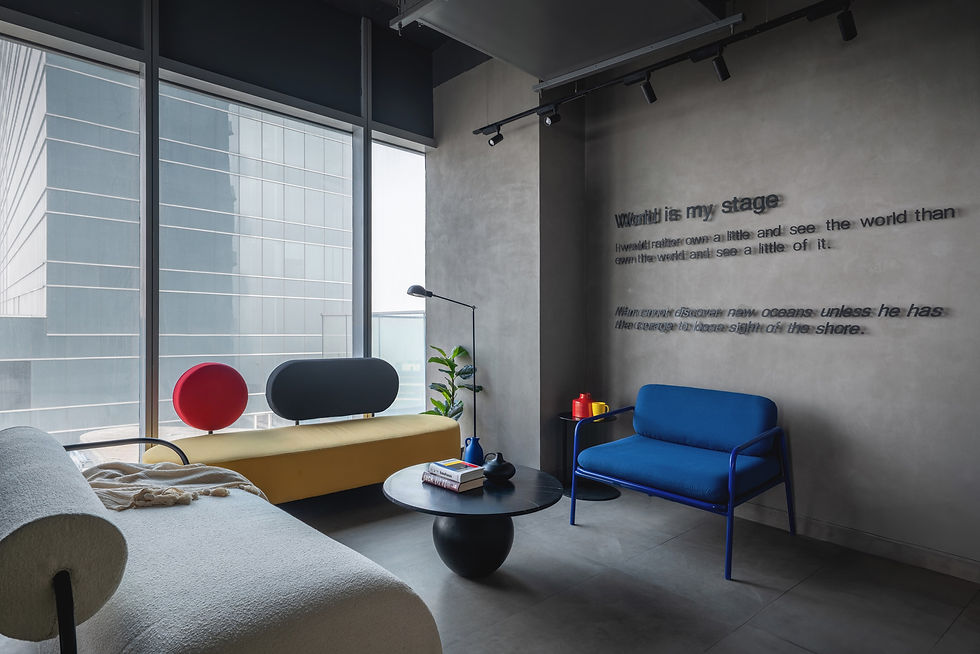
The client specifically wanted a breakaway from conventional office interiors. To achieve this, the design language focused on bold contrasts, geometric forms and playful use of colour. A monochromatic black-and-grey base was paired with accents of red, blue and yellow to introduce energy into the space without overwhelming it visually.
Abstract patterns and industrial finishes added character, while custom-designed furniture pieces became focal points throughout the office.
Rather than feeling like a traditional workplace, the office was designed to feel more like a creative studio where ideas and conversations flow naturally.
Design Tip: Adding controlled pops of colour within a neutral office palette can instantly make a workspace feel more energetic and memorable.
Making Every Corner Functional
In compact offices, every square foot matters.
The planning focused heavily on multifunctionality and hidden storage to ensure the office remained clutter-free. Storage solutions were integrated seamlessly into the furniture and walls to maintain clean visual lines throughout the space.
The seating layout was also carefully planned to support different kinds of interactions, from focused individual work to collaborative discussions and casual client meetings.
At the same time, the furniture placement was oriented carefully to maximise the panoramic city views and natural light entering the office.
Design Tip: Integrated storage helps small offices feel cleaner, calmer and significantly more spacious visually.
Using Lighting to Change the Mood of the Office
Lighting played a major role in softening the industrial and monochromatic palette. A layered combination of ambient, task and accent lighting was introduced to create warmth and depth throughout the office. Pendant fixtures, indirect lighting and focused task lights helped define different zones while making the office feel more inviting during evenings.
The lighting also helped highlight the custom furniture pieces and artistic details across the office.
Design Tip: Layered lighting instantly elevates compact office interiors and makes workspaces feel more dynamic and comfortable.

A Small Office Designed Around Creativity and Collaboration
The final outcome is a compact workspace that feels open, expressive and highly functional at the same time.
Despite being only 415 sq.ft, the office supports multiple modes of working while maintaining a strong visual identity. More importantly, it reflects the personality of the client, creative, unconventional and collaborative.
The project demonstrates how thoughtful planning, multifunctional design and a strong visual language can completely transform even the smallest office spaces into environments that inspire productivity, creativity and interaction naturally.



Comments